

How To Repair A Fruit Tree With Damaged Bark
- View Larger Image
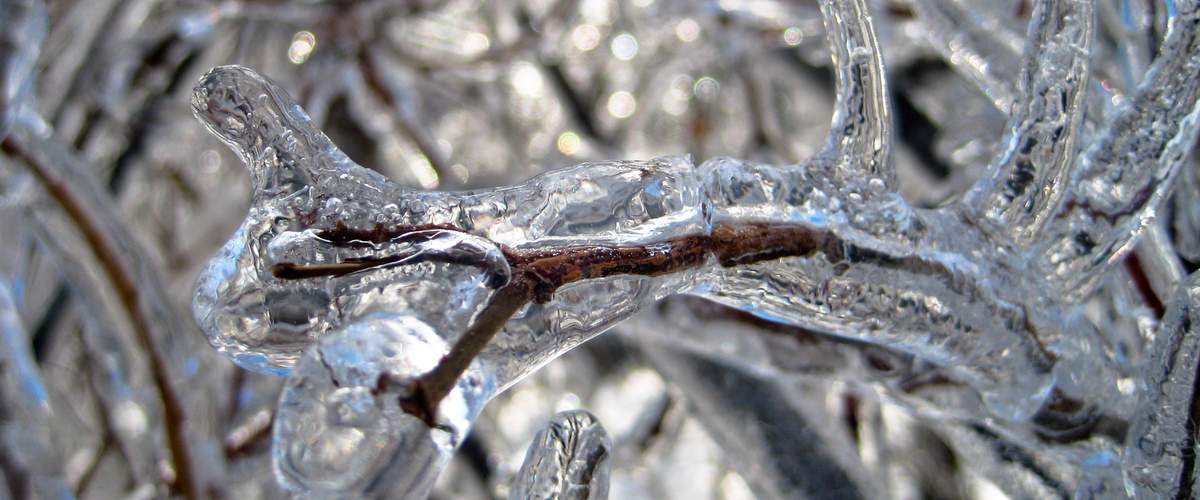
Tips to Repair Tempest-Damaged Copse
Days of sub-freezing temperatures, a dusting of snowfall, stiff winds, and a north-county ice storm for the record books. Suffice information technology to say, winter is in full swing in the Pacific Northwest, and whether you lot're in the midst of cleaning upwardly afterward the concluding storm or just desire to be prepared for the side by side time wicked conditions hits, here are some tips to have care of your copse.
First, take some time to appraise the harm to whatever of the trees effectually your grand. If any tree limbs accept cracked or a multi-body tree has split only has not separated completely and the bawl is still fastened to the tree, you may be able to repair the damage. Clip back the branching to remove some of the weight effectually the edges of the awning beginning. And so, with some help, lift the limb back into place and drill a hole through the broken portion of the branch and through the tree. Slide a bolt or threaded rod through the hole and thread nuts and washers onto both ends to concur the limb in place. If you lot're able to relieve plenty of the weight on the branch beyond the interruption to close the split or crack, you may exist able to stabilize the tree enough for the wound to heal properly.
Additionally, for damaged branches where the bark tore away from the tree but remained partially attached, yous may be able to salvage the bark using electrical tape. Every bit shortly as y'all can catch a break in the rain, tape the bawl back onto the tree and wrap the tree with electrical tape every bit yous would wrap a sprained wrist or talocrural joint. Over time, the tape will stretch every bit the tree grows and eventually interruption and autumn off, but in the meantime, it will secure the bawl in place and allow the tree to heal.
If, still, your tree has sustained damage beyond repair, yous may have no choice merely to finish the pruning job that the tempest started. When pruning a tree, whether large limbs or pocket-size branches, choosing the correct place to prune is key to helping a tree recover properly. The platonic place to prune off a co-operative is just beyond the indicate at which it diverges from the trunk or some other branch. Look closely at the place where a branch splits off the trunk of a tree and you'll meet a swollen area around the base of operations of the co-operative called the collar. When pruning, always cut at a slight bending away from the bottom of the joint to preserve the collar; doing so will allow the tree to heal properly. Never cut branches flush to the torso or the adjoining branch equally a tree is unable to properly scab over such a cutting and may eventually rot.
Finally, the well-nigh common enquiry I've received in the days since the ice storm is what I recommend using to seal wounds on a damaged tree. My answer? Zip! Pruning sealants—whether pigment-on or aerosol—provide an imperfect seal at all-time, and somewhen, water will work its way in behind the sealant. At that signal, the wound will be unable to breathe properly and rot can easily develop. And then, the best sealant is a combination of proper pruning and the tree's natural ability to heal.
Although the weather condition has moderated, winter is far from over—last twelvemonth, February brought snow, ice and cold weather for nearly the entire month—so get your trees back in shape and arm yourself with the tools and cognition yous need to help your trees recover from whatever the next storm brings!
Share This Story, Choose Your Platform!
two Comments

How To Repair A Fruit Tree With Damaged Bark,
Source: https://www.vandergiessennursery.com/2018/01/12/tips-to-repair-storm-damaged-trees/
Posted by: findleyshers1937.blogspot.com
I take a large Oak tree That was damaged in the hurricane Laura in Louisiana how practice I save it. Information technology has cracks up the trunk of the tree practise I record information technology with electrical tape or duct tape it is non the branches it is the trunk of the tree cheers for your fourth dimension
Hello Regina, I'm so lamentable y'all sustained impairment in Hurricane Laura! For an oak tree and for the cracks you're describing, I remember the best method to attempt to relieve the tree would exist to drill holes in it and bolt information technology dorsum together. It sounds drastic only it can piece of work!
The best fashion to do this is to use a long drill bit to drill through both halves of the tree, so run a long commodities through the tree with large washers on both ends. Then employ basics on the bolt to describe both sides of the tree back together. Over fourth dimension, the tree will heal over the bolt on its own and hopefully the trunk will grow back together.
For farther data and instructional videos, I would search YouTube for videos on bolting a tree back together. Thanks for checking with united states and I wish y'all all the best as you lot put things back together!
-David